Gallery Archives

Megawatt peak power from a Mamyshev oscillator

Megawatt peak power from a Mamyshev oscillator

Zhanwei Liu, Zachary M. Ziegler, Logan G. Wright, and Frank W. Wise. “Megawatt peak power from a Mamyshev oscillator” Optica, Vol. 4, Issue 6, pp. 649-654 (2017).

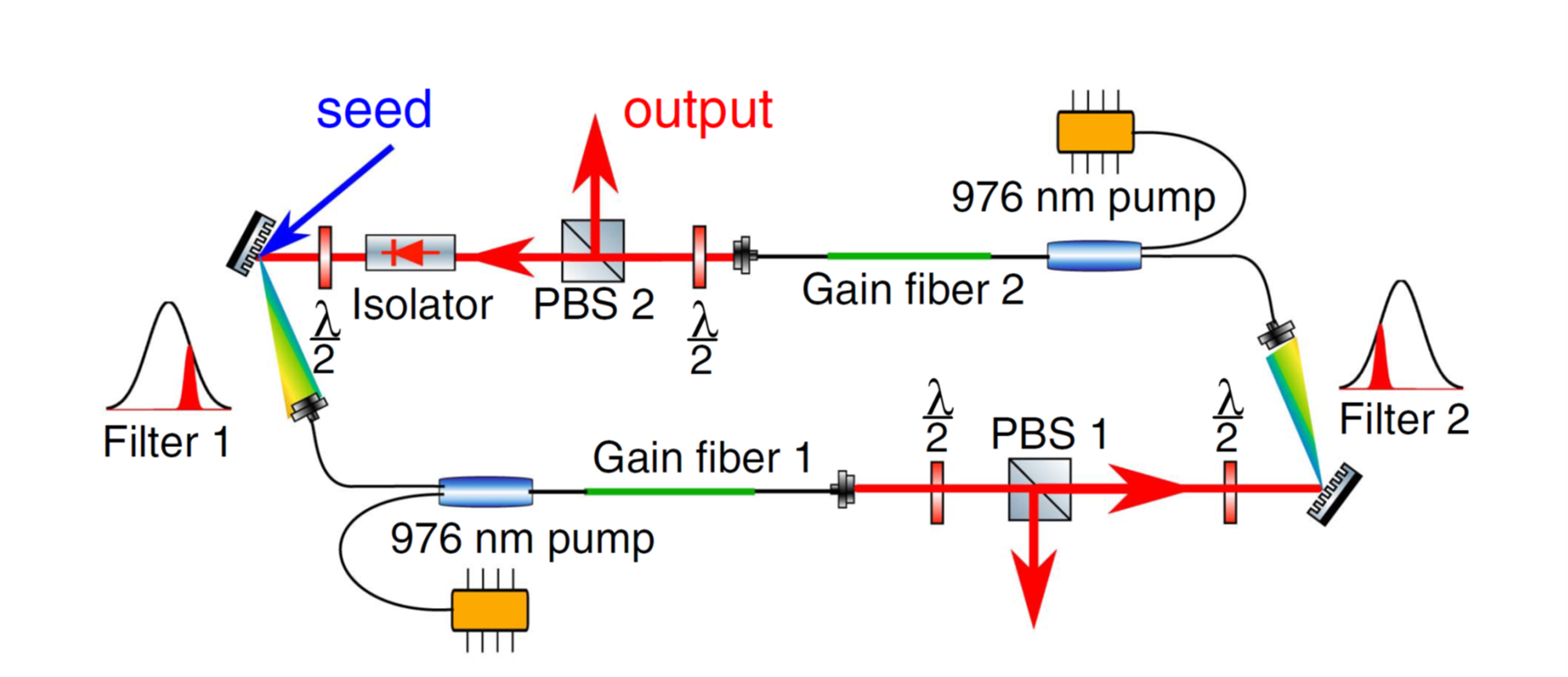
Historically, it has been really tough to make an ultrafast fiber laser that is both environmentally stable and that has good performance (i.e., it has similar performance as a Ti:sapphire oscillator). Recently, several groups have realized that a pair of spectral filters, each offset from the center of the laser gain spectrum, can be used as an effective saturable absorber. An intense pulse will experience nonlinear spectral broadening within fiber in between the filters, and can oscillate stably in a ring cavity formed in this way – a laser we call a ‘Mamyshev oscillator’ (see figure). Low-intensity pulses, or continuous-wave lasing, are meanwhile strongly attenuated. This mechanism, first proposed by Pavel Mamyshev for signal regeneration in telecommunications, is fully compatible with environmentally-stable laser designs. In this paper, we show that the Mamyshev oscillator can, when combined with the self-similar evolution of parabolic pulses, actually support extraordinary performance. Our initial experiments already show 10 times higher peak power than the previous state-of-the-art, and we are optimistic about further improvements.
High-power femtosecond pulses without a modelocked laser

High-power femtosecond pulses without a modelocked laser

Walter Fu, Logan G. Wright, and Frank W. Wise. “High-power femtosecond pulses without a modelocked laser” Optica, Vol. 4, Issue 7, pp. 831-834 (2017).

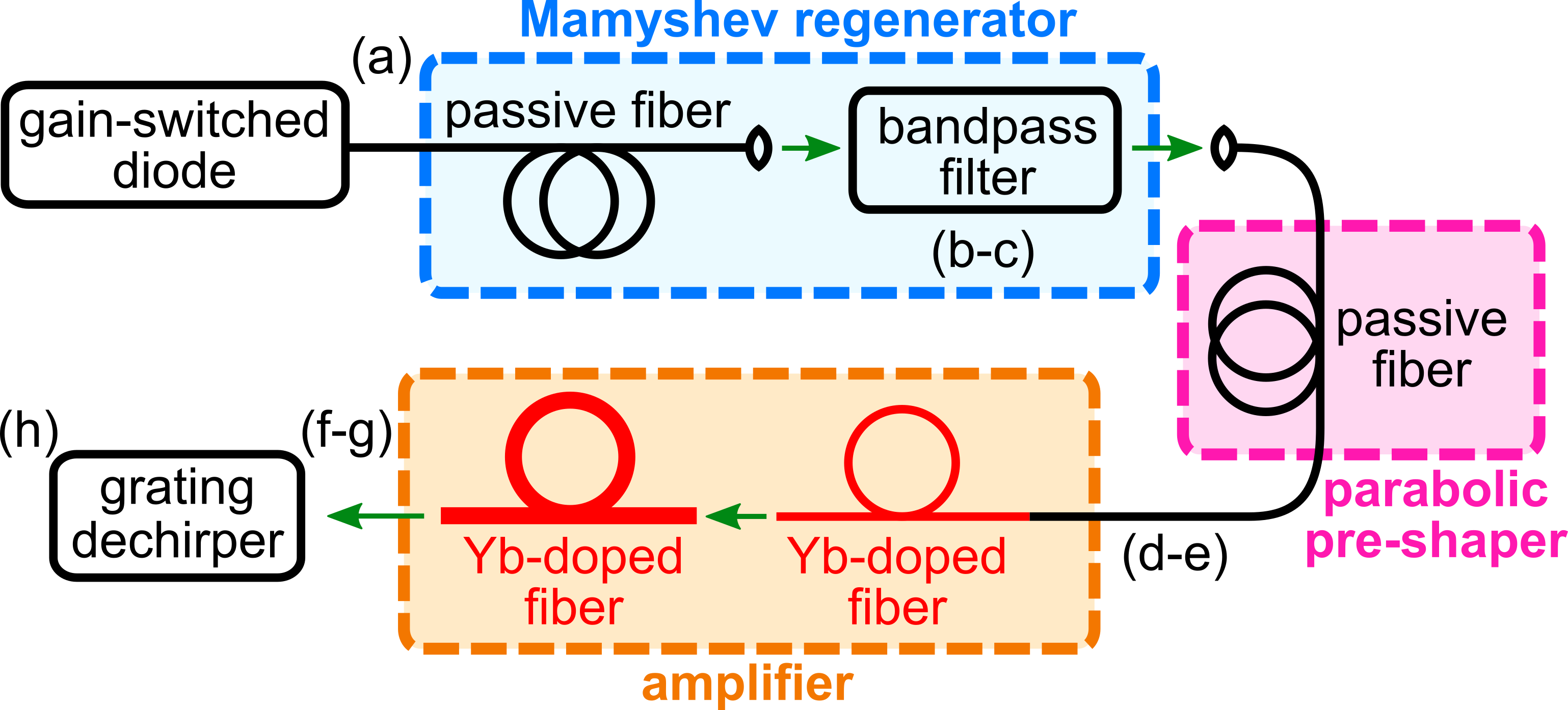
Modelocked lasers have long been a mainstay of ultrafast optics. However, they face ongoing challenges regarding long-term reliability, and can only emit pulses at regular intervals. Here, we present an alternative approach by seeding a fiber amplifier with a gain-switched diode. Gain-switched diodes emit pulses that are much longer and less coherent than those from modelocked oscillators. We address these issues using fiber nonlinearities: a Mamyshev regenerator isolates a coherent component of the pulse, and subsequent parabolic amplification allows the pulses to be compressed to 140 fs with 13 MW of peak power. Starting with a gain-switched diode means our system is highly robust and can in principle be electronically triggered in arbitrary pulse patterns. This flexibility may facilitate machining or microscopy sources (where pulses must be synchronized to scanning optics) or enable new types of functional neuroimaging (where specific neurons must be illuminated without saturating an entire sample).

Schematic of the demonstrated system.